
For Germany's established industrial leaders, the concept of transformation is not novel. However, the current paradigm shift is fundamentally different. It is no longer a strategic choice deliberated in boardrooms but an imperative for survival. This shift transcends incremental improvement; it demands a complete reinvention of how an organisation creates and delivers value, with Artificial Intelligence positioned at the epicentre of this change.
The Unavoidable Shift Redefining Corporate Strategy

For decades, German enterprises have exemplified operational excellence through optimisation. The pursuit of marginal efficiency gains is embedded in their corporate DNA. Yet, today’s market does not reward mere refinement; it demands reinvention.
This new wave of transformation shares little with past change management initiatives. The objective is not to enhance existing processes but to construct entirely new operational engines powered by intelligent systems.
This presents a stark choice for leadership: proactively re-architect the enterprise from within or face disruption by more agile, AI-native competitors. A reactive stance to market pressures is a strategy destined for failure. The sole viable path forward is what we term ‘re-ruption’—a deliberate, internal reinvention engineered to build a sustainable competitive advantage.
Why This Transformation Is Different
Previous initiatives often focused on digitalisation—migrating analogue processes to digital formats. The AI-driven transformation is more profound, fundamentally rewiring the core logic of business operations. Industry analysis confirms that leading organisations are not merely reducing costs; they are creating more effective, engaged, and productive workforces capable of driving substantive growth.
Consider these key distinctions:
- From Data Collection to Data Intelligence: The legacy objective was data aggregation. The current mandate is to leverage AI for predictive insights and automated, real-time decision-making.
- From Process Automation to Cognitive Automation: Robotic Process Automation (RPA) excelled at automating simple, repetitive tasks. AI introduces cognitive capabilities, enabling the management of complex, variable challenges across functions from supply chain logistics to customer engagement.
- From Product-Centric to Ecosystem-Centric: AI facilitates the creation of interconnected services and intelligent products that generate recurring value, liberating the business from transactional, single-purchase models.
The central challenge is no longer technology adoption. It is the fundamental re-architecting of the company’s operating model around the novel capabilities that AI unlocks. This is not an IT project; it is a C-level strategic imperative.
This internal reinvention is paramount to future-proofing your organisation against global competition and securing long-term market leadership. The implications for your organisational structure and workforce are significant, a topic explored in our guide to the future of working. It is about building an enterprise that is not just resilient, but perpetually innovative.
The Four Pillars of AI-Powered Transformation
To execute a corporate-wide transformation driven by AI, leaders require a robust, coherent framework. Embarking on AI adoption without a clear strategic blueprint is analogous to constructing a factory without architectural plans—an exercise in chaos, inefficiency, and inevitable failure. A successful transformation rests upon four interdependent pillars, each addressing a critical component of the journey, from high-level vision to shop-floor execution.
Ready to Build Your AI Project?
Let's discuss how we can help you ship your AI project in weeks instead of months.
This is not an abstract academic model but a practical guide for C-level executives and their teams to direct investment, mitigate risk, and achieve measurable outcomes. Consider it a strategic playbook for leading enterprise-wide change.
Pillar 1: AI Strategy
A robust AI strategy is not a portfolio of disparate pilot projects. It is a detailed roadmap that explicitly links every technology initiative to the company’s P&L. The primary objective is to identify and prioritise use cases that will generate maximum business value—be it through process optimisation, new revenue streams, or a distinct competitive advantage.
This demands a rigorous, objective assessment of current capabilities and strategic opportunities. As a recent Forrester study highlights, a mindset of continuous modernisation is essential to meet evolving customer expectations and maintain profitability. This pillar ensures that every euro invested in AI is a calculated move toward a defined business objective, not a speculative technological experiment.
An AI strategy disconnected from clear business outcomes is merely a theoretical exercise. The true measure of a successful transformation is the ability to articulate precisely how an AI initiative will impact revenue, margins, or market share.
Learn more about crafting a strategy that bridges the gap between technical possibility and commercial viability by exploring our approach to AI strategy development.
Pillar 2: AI Engineering
If strategy defines the destination, engineering provides the vehicle. This pillar encompasses the technical discipline of building and deploying AI systems that are robust, scalable, and seamlessly integrated into existing operational workflows. It is where strategic vision is translated into functional reality.
The critical challenge lies in moving beyond the prototype stage. A model that performs flawlessly in a controlled laboratory environment is distinct from an enterprise-grade solution that operates reliably under real-world pressures. Advances in Artificial Intelligence are redefining business at its core, forming the nucleus of new corporate strategies. This pillar addresses the complex technical requirements—data pipelines, model deployment, infrastructure—to ensure solutions are not only intelligent but also stable and maintainable.
Pillar 3: AI Security and Compliance
For any German industrial enterprise, particularly within the automotive or manufacturing sectors, security and compliance are non-negotiable prerequisites. This pillar focuses on establishing the essential governance and risk management frameworks to safeguard corporate and customer data. It ensures that innovation does not introduce unacceptable security vulnerabilities or regulatory liabilities.
This includes implementing stringent data governance protocols, protecting AI models from adversarial threats, and ensuring compliance with standards such as TISAX or ISO certifications. A failure in this domain exposes the organisation to significant financial, reputational, and legal risks.
- Data Governance: Defining data ownership, access controls, and quality standards for all data powering AI systems.
- Model Security: Protecting algorithms from manipulation, adversarial attacks, or data poisoning.
- Regulatory Adherence: Ensuring all AI applications are fully compliant with GDPR and other industry-specific regulations.
Pillar 4: AI Enablement
Ultimately, technology is an enabler; people are the agents of change. This final pillar is dedicated to cultivating an internal culture of innovation and equipping teams with the requisite skills to operate effectively in an AI-first environment. It is about building a self-sustaining innovation capability within the organisation.
Want to Accelerate Your Innovation?
Our team of experts can help you turn ideas into production-ready solutions.
A 2023 survey revealed that 48% of organisations identify a lack of requisite IT skills as a primary impediment to progress. AI enablement directly addresses this deficit through structured training, hands-on coaching, and knowledge transfer programs. The objective is to empower employees to become active participants in the transformation, fostering a culture where data-driven decision-making becomes standard operating procedure. This ensures that momentum is sustained long after initial project completion.
The Four Pillars of AI Transformation: A Strategic Overview
This table synthesises the framework, outlining how each pillar aligns with a strategic objective to deliver tangible business outcomes. It provides a concise visualisation of the complete model.
| Pillar | Strategic Objective | Key Business Outcomes |
|---|---|---|
| AI Strategy | Align AI initiatives with core business goals and P&L impact. | Increased revenue, improved margins, and sustainable competitive advantage. |
| AI Engineering | Build and deploy robust, scalable, and production-ready AI systems. | Reliable operational performance, seamless integration, and faster time-to-value. |
| AI Security & Compliance | Protect data assets and ensure adherence to all regulatory standards. | Mitigated legal and financial risks, enhanced customer trust, and brand protection. |
| AI Enablement | Develop in-house skills and foster a culture of data-driven innovation. | Increased employee adoption, long-term self-sufficiency, and continuous improvement. |
Each pillar is indispensable. Neglecting one undermines the efficacy of the others. When executed in concert, they form a powerful, repeatable roadmap for any organisation committed to genuine transformation.
A Practical Roadmap For Implementing Your Transformation
Understanding the potential of AI is one matter; executing its implementation to achieve a tangible return on investment is another. A successful business transformation is not a monolithic project launched with speculative hope. It is a structured journey of deliberate steps focused on discovery, validation, scaling, and continuous refinement.
This approach eschews traditional project management methodologies, which can stifle innovation with bureaucracy, in favour of an agile, entrepreneurial mission. The goal is to deliver value to the business expeditiously, learn from empirical results, and make informed, evidence-based decisions at each stage. This roadmap provides leadership with a clear pathway from initial concept to enterprise-wide impact.
Looking for AI Expertise?
Get in touch to explore how AI can transform your business.
The journey is structured around the four interdependent pillars: Strategy, Engineering, Security, and Enablement.
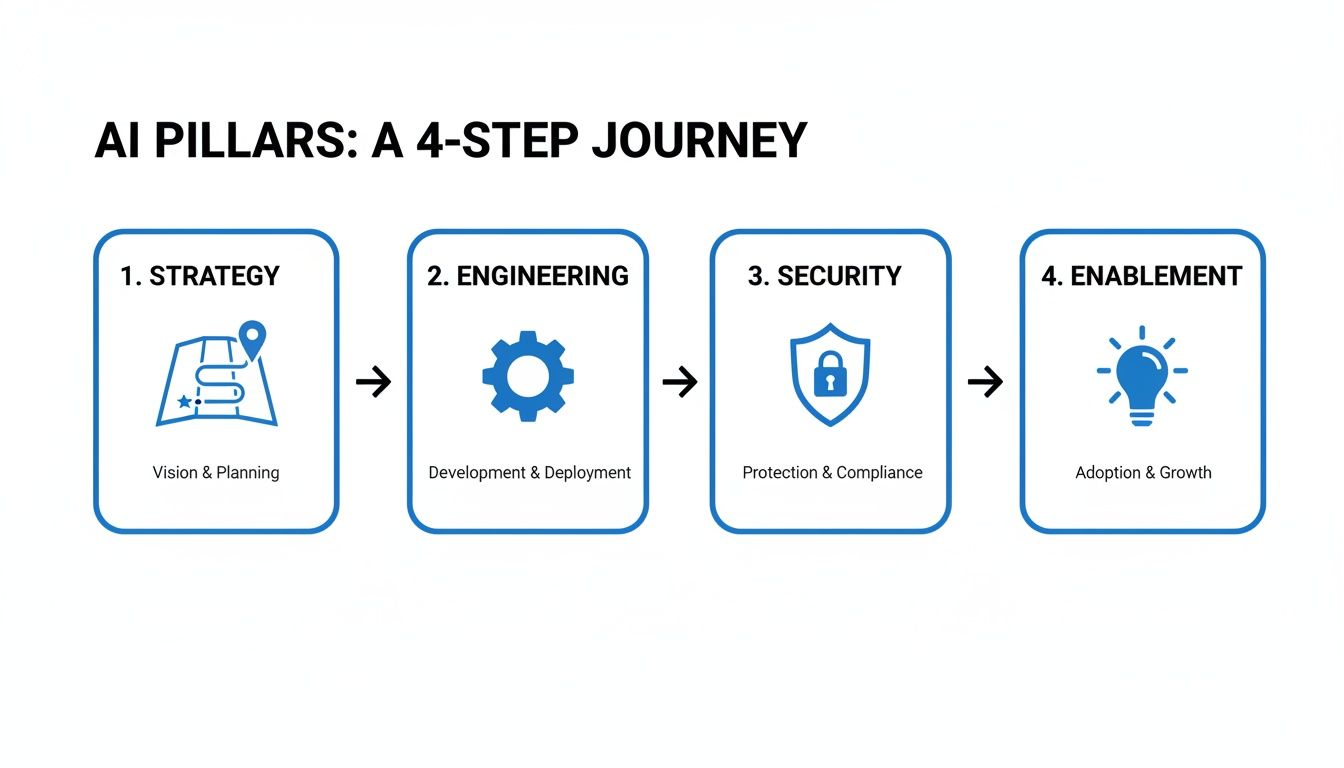
This is not a sequential checklist but a holistic effort. A coherent strategy, sophisticated engineering, robust security, and an empowered team must advance in unison for the transformation to succeed.
Phase 1: Discovery and Strategy (Weeks 1-4)
The initial phase is an exercise in focus. The objective is not to address all possibilities but to pinpoint a select few high-impact, achievable domains where AI can deliver clear, measurable value. This stage is critical for constructing a compelling business case that secures executive sponsorship and aligns organisational efforts.
This involves cross-functional workshops to generate ideas, followed by a rigorous filtration process based on technical feasibility, potential ROI, and alignment with overarching corporate strategy.
Ready to Build Your AI Project?
Let's discuss how we can help you ship your AI project in weeks instead of months.
- Key Actions: Conduct stakeholder interviews, map current processes to identify critical bottlenecks, and isolate use cases with direct P&L impact.
- Deliverables: A prioritised list of 2-3 AI use cases, a high-level concept summary for each, and a formal business case detailing projected costs and benefits.
- Success Metric: C-suite approval to proceed to the prototyping phase.
Phase 2: Prototyping and Validation (Weeks 5-10)
With a defined target, phase two prioritises speed and empirical proof. This is the transition from deliberation to execution. Rather than engaging in protracted analysis, the mission is to build a functional prototype that tests core assumptions. This is the most efficient method to de-risk the investment before committing significant capital.
This hands-on approach yields invaluable early feedback from end-users and provides hard data on the solution’s viability. It is how one rapidly determines if a concept is sound or requires re-evaluation. Our 21-day AI delivery framework offers a proven methodology for accelerated execution.
A working prototype is more persuasive than a thousand PowerPoint slides. It transforms an abstract concept into a tangible asset that leadership can evaluate directly. This makes the decision to scale an evidence-based conclusion, not a leap of faith.
Phase 3: Scaling and Integration (Months 3-9)
Once the prototype has demonstrated its value, the focus shifts from a controlled experiment to the development of a production-grade system. This phase involves addressing the complex engineering, security, and compliance challenges required to integrate the solution into existing technology stacks and business workflows. It is at this stage that many transformation initiatives falter without expert execution partners.
The demand for such partners is substantial. Germany's management consulting industry alone comprises 90,441 businesses generating €47.7 billion in revenue, with a 3.0% annual growth rate since 2020. In this context, a partner who functions as a "Co-Preneur"—sharing risk and accountability for results—becomes an invaluable asset.
Phase 4: Optimisation and Enablement (Ongoing)
Deployment is not the finish line; it is the starting point for continuous improvement. This final, ongoing phase centres on monitoring performance, gathering user feedback, and iteratively enhancing the system. Equally important is the systematic transfer of knowledge to internal teams.
The ultimate objective is to build a self-sustaining internal engine for innovation. This requires structured training, comprehensive documentation, and the cultivation of a culture where data-driven decision-making becomes ingrained. By enabling your own teams, you ensure the value generated by the transformation not only endures but grows over the long term.
Real-World Examples: Transformation in German Industry

Frameworks and roadmaps are instructive, but their true validation lies in real-world application. For leaders in German industry, tangible results within familiar sectors provide the ultimate proof of concept.
The following examples from Germany’s automotive and manufacturing sectors illustrate the outcomes when a focused, problem-first approach to AI is implemented. These are not merely technology projects; they are solutions to genuine business challenges that create a significant competitive advantage.
Automotive: Redefining Talent Acquisition
For a global leader like Mercedes-Benz, acquiring and retaining top-tier talent is a core strategic priority, not merely an HR function. Their legacy recruitment process was impersonal and inefficient, failing to provide the immediate, 24/7 engagement expected by a high volume of candidates. The business problem was clear: how to enhance the candidate experience at scale without a proportional increase in HR headcount.
The solution was an intelligent, NLP-powered recruiting chatbot. This was not a rudimentary keyword-matching bot but a sophisticated system designed to understand context, address complex inquiries, and guide applicants seamlessly through the initial stages of the hiring process.
- The Problem: High-volume, inefficient communication was creating a poor applicant experience.
- The AI Solution: An NLP chatbot providing 24/7 personalised interactions, answering queries, and pre-qualifying candidates.
- The Result: A significantly improved candidate journey, reduced administrative burden on the HR team, and a strengthened employer brand.
This project exemplifies how targeted AI can transform a critical support function from a cost centre into a strategic asset. You can explore the Mercedes-Benz recruiting chatbot project for a detailed analysis of its impact.
From Corporate Lab to Market-Ready Startup
Large corporations often possess brilliant research that fails to transition from the laboratory to a market-ready product. STIHL, a manufacturing powerhouse, faced this precise challenge with a promising internal innovation. The path from a technical concept to a viable corporate venture was unclear and fraught with risk.
The transformation involved adopting an entrepreneurial framework—what we term the "Co-Preneur" model. Instead of navigating protracted internal review cycles, the project was managed as a lean startup. Over two years, the focus was on rapid customer research, prototyping, and iteration based on market feedback. Each step was designed to methodically de-risk the venture.
Want to Accelerate Your Innovation?
Our team of experts can help you turn ideas into production-ready solutions.
Successful transformation often requires leaders to adopt a venture capitalist mindset. One must make calculated investments in internal innovations and provide them with the agile framework necessary to thrive outside the conventional corporate structure.
This case demonstrates how established industrial players can incubate internal startups to create new value streams, operating with the speed and agility of a smaller, more nimble organisation.
Manufacturing: AI-Driven Efficiency Gains
Germany's manufacturing sector is the engine of its economy and a focal point for digital transformation. This industry alone constitutes 29.75% of the nation's total digital transformation market, driven by Industry 4.0, the transition to electric mobility, and intense global supply chain pressures.
Siemens' facility in Erlangen provides a compelling example of AI's impact. By implementing intelligent production lines, the company achieved energy savings of up to 20% and increased labour productivity by 15-30% in pilot implementations. These are not incremental improvements but new benchmarks for the Mittelstand.
These examples are not anomalies. They are clear indicators of the potential when a precise strategy is executed with technical excellence, all focused on solving a specific business problem.
Navigating Common Pitfalls in Your Transformation Journey
Even the most meticulously planned business transformations can encounter significant obstacles. The path from a strategic vision to tangible results is fraught with potential roadblocks that can derail momentum and consume resources. For any executive, anticipating these challenges is not just good practice—it is essential for success.
Proactively addressing these common pitfalls builds resilience into your strategy. It is the difference between reactive crisis management and strategic navigation, ensuring the initiative delivers its promised value.
Overcoming Analysis Paralysis
The vastness of data and the myriad possibilities of AI can be overwhelming, often leading to a state of analysis paralysis. Teams become trapped in a cycle of perpetual research and planning, hesitant to commit to a course of action for fear of error. The result is a squandering of time, resources, and organisational momentum.
The antidote is to adopt an entrepreneurial mindset focused on rapid prototyping. Defer the objective of a perfect, comprehensive plan and instead prioritise testing key assumptions through small, swift, manageable experiments. This approach de-risks innovation; failure becomes an inexpensive, accelerated learning opportunity rather than a catastrophic event.
The initial objective is not to possess all the answers, but to build a mechanism for discovering them quickly. A working prototype developed in two weeks will yield more actionable insight than a strategic presentation deck can in two months.
Looking for AI Expertise?
Get in touch to explore how AI can transform your business.
Securing C-Level Sponsorship and Alignment
A business transformation is not an IT project; it is a fundamental change to the enterprise operating model. Without unequivocal, visible support from senior leadership, any large-scale initiative is destined to fail. A lack of executive sponsorship leads to resource conflicts, inter-departmental resistance, and a pervasive sense that the initiative is not a genuine corporate priority.
C-level sponsorship must extend beyond budget approval. It requires active championship of the vision.
- Communicate the 'Why': Leaders must consistently articulate why this transformation is critical to the company's future, linking it directly to strategic objectives.
- Remove Obstacles: Executives must act as facilitators, resolving cross-functional conflicts and empowering the transformation team with the authority needed for execution.
- Model the Change: The leadership team must embody the desired changes. If the goal is to become more data-driven, they must lead by example in their own decision-making processes.
Escaping Pilot Purgatory
A significant number of promising AI initiatives begin as successful pilot projects, only to stagnate and fail to achieve full-scale deployment. This state of limbo is known as pilot purgatory. It occurs when a concept is proven viable, but no clear pathway exists to integrate it into daily operations. The typical causes are legacy technology constraints, bureaucratic inertia, and a failure to plan for scale from the outset.
To avoid this pitfall, scalability must be a consideration from Phase 1. Design the prototype with future integration in mind and establish clear, predefined criteria for pilot success. The triggers and handover processes that transition a project from experiment to a fully funded, production-ready system must be defined in advance.
Managing Internal Resistance and Data Governance
Ultimately, technology is implemented by people, who often exhibit a natural resistance to change rooted in fear of the unknown or perceived job insecurity. This human element, if unmanaged, can subvert the most sophisticated technical solution. Concurrently, inadequate data governance can cripple an AI project, as even the most advanced algorithm is rendered useless by poor-quality data.
Ready to Build Your AI Project?
Let's discuss how we can help you ship your AI project in weeks instead of months.
A robust change management plan is non-negotiable. This entails clear communication, transparent processes, and training programs designed to upskill employees rather than render them obsolete. Simultaneously, strong data governance and compliance frameworks must be established from day one. Our article on risk management and compliance provides a deeper analysis of building this secure foundation.
Choosing Your Transformation Partner
The decision of which external partner to engage is among the most critical in any transformation initiative. For decades, the default has been to retain management consultants, who excel at analysis, strategy formulation, and delivering polished presentations. However, a significant gap often exists between their strategic roadmap and the operational reality of implementation.
This traditional consultant-client relationship can be transactional. While the advice may be sound, accountability frequently concludes with the delivery of the final report, leaving internal teams to navigate the technical and cultural challenges of execution alone. For change to be truly embedded, a different partnership model is required—one predicated on shared accountability.
The Emerging Co-Preneur Model
A new paradigm is gaining traction: the Co-Preneur model. This approach reframes the conventional client-vendor dynamic. Instead of a service provider, the organisation gains a genuine partner who operates at eye-level, sharing responsibility for achieving business outcomes. This model is designed for enterprises that require not just a roadmap, but an execution partner who will build the future alongside them.
This model prioritises entrepreneurial speed over protracted consulting engagements. The focus shifts from exhaustive upfront analysis to rapid prototyping and tangible progress. A Co-Preneur does not merely advise from the periphery; they embed within your teams, transfer knowledge, and help develop your internal capabilities. When tackling a transformation as complex as one powered by AI, securing the right technical expertise is essential; a guide to data engineering consulting services can be invaluable in defining the necessary roles and skills.
Want to Accelerate Your Innovation?
Our team of experts can help you turn ideas into production-ready solutions.
The core differentiator is motivation. A traditional consultant is compensated for delivering a plan. A Co-Preneur is incentivised to deliver a working innovation that creates quantifiable value. The objective is not just to advise—it is to build with you.
Therefore, selecting a partner is a strategic decision that directly influences the risk profile and ultimate success of the entire initiative. The critical question for leadership is: Do we require an architect to draw the map, or a co-pilot to navigate the aircraft through turbulence and ensure a safe landing? For any genuine transformation in business, the answer is invariably the co-pilot.
Common Questions We Hear About Transformation
Initiating a major business transformation invariably raises critical questions from the leadership team. Addressing these inquiries clearly from the outset is essential for achieving organisational alignment. Here are our direct answers to the most frequently asked questions.
So, Where Do We Actually Start?
Begin not with technology, but with a specific, high-value business problem. Avoid the common pitfall of developing a vague "AI strategy." Instead, identify a tangible operational bottleneck or an unexploited revenue opportunity.
Select a single use case where success can be clearly defined and measured. This approach simplifies the creation of a compelling business case, facilitates board-level approval, and enables an early, demonstrable win. This initial success generates the momentum required for the broader transformation journey.
Looking for AI Expertise?
Get in touch to explore how AI can transform your business.
The optimal first step in any transformation is to solve a pressing business problem with a measurable outcome. This de-risks the initiative, demonstrates immediate value, and simplifies the process of securing long-term executive buy-in.
And How Do We Know If This Is Actually Working?
Success must be measured in terms of business metrics, not simply project milestones. Before initiating any project, define what success looks like using the key performance indicators (KPIs) that matter to your C-suite.
These metrics may include:
- Operational Efficiency: Reductions in cycle times, decreases in operational costs, or lower error rates.
- Commercial Growth: Increases in revenue, development of new revenue streams, or higher customer lifetime value.
- Customer Satisfaction: Improvements in Net Promoter Score (NPS) or other customer satisfaction indices.
By linking every initiative to a concrete business outcome, you enable transparent ROI tracking and build a clear justification for continued investment. This reframes the internal conversation from "What is the cost?" to "What is the value being created?"
A successful transformation in business requires more than a strategic plan; it demands a true partnership built on shared risk and an ownership mindset. At Reruption GmbH, we do not just advise—we act as your Co-Preneurs, building alongside you to translate bold ideas into tangible, market-ready results. Discover how we deliver measurable outcomes at https://www.reruption.com.
Ready to Build Your AI Project?
Let's discuss how we can help you ship your AI project in weeks instead of months.