
Digital asset management software serves as the central command centre for an enterprise's entire content universe. It establishes the single source of truth for every digital file—from product photography and campaign videos to critical design files and marketing materials. Without this foundational system, organisations face siloed workflows, brand inconsistencies, and significant compliance liabilities.
Why Digital Asset Management Is a Strategic Imperative
In today's competitive landscape, managing brand and product content across a multitude of channels is not merely a marketing function—it is a C-suite challenge. Corporate teams continuously generate a high volume of images, videos, and documents to support activities ranging from social media campaigns and e-commerce platforms to sales presentations and partner portals. Absent a centralised governance framework, this content library rapidly degrades into a state of inefficiency and risk.
This is precisely where digital asset management (DAM) software transitions from a tactical tool to a strategic business necessity. A DAM is not a sophisticated file storage solution; it is the foundational system that imposes order and drives operational excellence in the creation, management, and distribution of an organisation's most valuable brand and product assets.

From Digital Chaos to Competitive Advantage
The consequences of unmanaged digital assets are tangible, imposing a significant drag on an enterprise's agility. Teams expend countless hours searching for correct files, outdated brand assets infiltrate critical campaigns, and the unauthorised use of content exposes the business to severe legal and financial penalties.
Ready to Build Your AI Project?
Let's discuss how we can help you ship your AI project in weeks instead of months.
A modern DAM system inverts this chaotic state, transforming it into a clear competitive advantage by addressing core business challenges directly:
- Accelerating Time-to-Market: It provides teams with immediate, controlled access to approved assets, enabling marketing and creative functions to launch campaigns and products with maximum velocity.
- Enforcing Brand Consistency: It ensures that only the latest, on-brand creative is deployed across all channels, safeguarding the brand integrity meticulously built over years.
- Mitigating Compliance Risks: It systematically tracks usage rights, licenses, and expiration dates, automatically preventing the use of expired or non-compliant media.
- Maximising Asset ROI: By facilitating the discovery and reuse of content, it eliminates the substantial cost of recreating existing assets.
A Growing Market Driven by Efficiency
The demand for these strategic benefits is driving exponential market growth. Germany currently represents the largest share of the European digital asset management software market, a region valued at USD 2.2 billion. Projections indicate the European DAM market will reach USD 8.0 billion by 2033, driven significantly by AI-powered automation that enables organisations to catalogue assets 40% faster.
Implementing a DAM is a direct investment in an organisation's operational intelligence. It provides the control necessary to manage the corporate brand narrative, protect intellectual property, and operate with a level of precision unattainable through distributed cloud drives and shared folders. For marketing leaders, mastering specialised marketing asset management software is essential for streamlining creative workflows and ensuring brand consistency across every campaign.
Core Capabilities of an Enterprise DAM Platform
To fully grasp the value proposition of an enterprise-grade digital asset management platform, it is essential to look beyond the concept of simple storage. A DAM is not a passive library; it is an active, intelligent framework engineered to manage the entire lifecycle of an organisation's critical media. Its purpose is to inject control, velocity, and intelligence into content operations.
Consider the DAM as a highly competent corporate archivist, possessing complete knowledge of every piece of media the company has ever produced. This is not a static repository but a dynamic engine that actively governs how assets are discovered, utilised, and secured, ensuring maximum return on content investment.
A Single, Searchable Source of Truth
At its core, a DAM platform resolves the fundamental challenge of asset discovery. It consolidates every digital asset—from product photography and campaign videos to technical drawings and brand guidelines—into a single, authoritative hub. This centralisation alone eliminates the significant waste of time and resources associated with siloed file storage, where assets are frequently lost or unnecessarily recreated.
However, consolidation is merely the initial step. The platform's true power lies in its application of advanced metadata and taxonomy to ensure discoverability.
- Metadata: This encompasses the descriptive data linked to each file. A robust DAM allows for the creation of customised metadata schemas, including everything from product SKUs and campaign identifiers to copyright information and talent usage rights.
- Taxonomy: This is the logical framework—the folders and categories—that organises the asset library. A well-designed taxonomy mirrors the organisation's operational structure, making navigation intuitive for all users.
The combination of these elements transforms a chaotic collection of files into a highly organised, instantly searchable library. The hours previously lost to content searches are reclaimed as productive time.
Iron-Clad Governance and Control
In any large enterprise, governing the use and distribution of assets is a business-critical function. A proper digital asset management software solution establishes strict governance protocols to protect the brand and mitigate legal risks.
A vital feature is version control, which ensures that only the latest, approved version of any asset is in circulation. Obsolete logos, draft designs, and unapproved campaign imagery are systematically archived, preventing their accidental use in public-facing materials and the subsequent dilution of brand identity.
Want to Accelerate Your Innovation?
Our team of experts can help you turn ideas into production-ready solutions.
A DAM system is the operational backbone for brand integrity. It ensures that every asset deployed across every channel—from a regional sales presentation in Munich to a global product launch—is consistent, compliant, and current.
Furthermore, the system enables granular access control through precise permissions. User roles and groups can be configured to restrict access to sensitive or confidential assets, a critical requirement for managing pre-launch product imagery, internal communications, or licensed content with stringent usage limitations.
The AI Automation Engine
Modern DAM platforms are increasingly augmented with Artificial Intelligence, which automates a significant volume of manual tasks and uncovers new operational insights. For German enterprises that prioritise operational excellence, these AI capabilities are not novelties; they are powerful efficiency multipliers. AI can analyze image or video content and automatically generate relevant metadata tags—a task that would otherwise require hours of manual labour.
This intelligent automation transforms a passive content repository into a proactive business instrument. For instance, AI can identify products, logos, and even specific individuals within assets, enabling powerful new search methodologies across the entire archive. This represents a paradigm shift for organisations seeking to accelerate content production and extract greater value from existing media. By offloading repetitive work to AI, organisations can reduce project timelines and reallocate human capital to high-value creative and strategic initiatives.
Building a Connected Content Ecosystem with DAM Integrations
A standalone DAM platform is analogous to a perfectly organised, yet static, library. An integrated DAM, however, functions as the central nervous system of the entire content operation. Its true power is realised not just in storing assets, but in its ability to communicate with other critical business systems, dismantling silos and creating a fluid content ecosystem.
Looking for AI Expertise?
Get in touch to explore how AI can transform your business.
This connectivity elevates the DAM from a passive repository to an active hub that orchestrates brand consistency across every corporate touchpoint.
Consider a typical product launch scenario. Without integration, the marketing team manually downloads approved images and uploads them to the content management system. Simultaneously, the sales team searches shared drives for the latest presentation, hoping to find the correct version. The process is inefficient, error-prone, and poses a significant brand risk.

An integrated DAM fundamentally transforms this workflow. Approved product assets flow automatically into downstream platforms, eliminating friction and ensuring perfect synchronisation. The objective is to maximise the value of existing technology investments.
Key Integration Points for Enterprise Synergy
Constructing this connected ecosystem involves linking the DAM to platforms that drive core business functions. Each integration serves a specific strategic purpose, converting isolated data streams into a unified operational force. The primary goal is to deliver the right content to the right system at the right time.
Ready to Build Your AI Project?
Let's discuss how we can help you ship your AI project in weeks instead of months.
Key integration points include:
- Product Information Management (PIM): For manufacturing and e-commerce enterprises, this integration is non-negotiable. Linking the DAM and PIM ensures every product listing is automatically populated with its latest, approved imagery and technical documentation, eliminating manual effort and data inconsistencies.
- Content Management System (CMS): Connecting the DAM directly to a CMS—such as WordPress, Drupal, or Adobe Experience Manager—allows web teams to pull approved assets directly into digital experiences. This eliminates download/re-upload cycles and ensures that asset updates in the DAM are reflected automatically on the web, guaranteeing brand consistency.
- Customer Relationship Management (CRM): Integrating the DAM with a CRM like Salesforce or HubSpot equips sales teams with the latest case studies, presentations, and datasheets directly within the customer records they use daily. This ensures they are always on-brand and utilizing the most current materials.
The following table outlines the function and business impact of key DAM integrations.
Strategic DAM Integration Points and Business Impact
| System to Integrate (e.g., PIM, CMS) | Primary Function of Integration | Key Business Outcome for Enterprise |
|---|---|---|
| PIM (Product Information Management) | Automatically links approved product assets (images, videos, docs) to corresponding product data records. | Guarantees product listings are always accurate and visually consistent, accelerating time-to-market and reducing e-commerce errors. |
| CMS (Content Management System) | Enables web and marketing teams to directly access and embed approved assets from the DAM into web pages and digital experiences. | Radically speeds up content publishing, ensures brand consistency across all web properties, and simplifies asset updates. |
| CRM (Customer Relationship Management) | Provides sales and service teams with direct, in-platform access to the latest sales collateral, presentations, and case studies. | Empowers sales teams with up-to-date materials, improves sales pitch consistency, and shortens the sales cycle. |
| Marketing Automation Platform | Feeds approved campaign assets directly into email, social media, and advertising workflows. | Increases campaign agility, ensures all marketing communications are on-brand, and allows for better performance tracking of assets. |
| Creative Tools (e.g., Adobe CC) | Allows creative teams to check assets in and out of the DAM directly from their design software, streamlining the creative workflow. | Reduces friction for designers, automates version control, and accelerates the feedback and approval process from brief to final asset. |
Each integration point is designed to eliminate a specific bottleneck, automate a manual process, and ultimately drive superior business results by ensuring a seamless flow of content to its point of need.
Automating Workflows and Eliminating Silos
The ultimate benefit of a well-integrated digital asset management software solution is automation. For example, an integration can automatically push a finalised campaign video from Adobe Creative Cloud into the DAM, apply the correct project metadata, and notify the marketing team for review.
This is not merely about time savings; it is about fundamentally re-engineering inter-departmental collaboration. It dismantles the operational barriers between creative, marketing, sales, and product teams.
Want to Accelerate Your Innovation?
Our team of experts can help you turn ideas into production-ready solutions.
By serving as the single source of truth for content that feeds all other systems, the DAM ensures that every department operates from the same playbook. This eliminates content duplication, reduces the risk of using non-compliant assets, and creates a seamless flow of information across the organisation.
For large German enterprises committed to operational excellence, this unified approach is paramount. Automating these content handoffs enhances efficiency and establishes a clear audit trail for every asset, delivering significant governance and control benefits. To understand how intelligent systems can further amplify this, explore the potential of an internal LLM engine for cross-functional automation.
Ultimately, integrating a DAM is not a technical exercise. It is a strategic initiative to build a more intelligent, agile, and consistent content operation.
Building the Business Case for Digital Asset Management
Securing executive approval for any significant technology investment requires a robust business case. The argument for digital asset management is not about acquiring another software license; it is about investing in an engine for growth and efficiency, rather than establishing another cost centre.
The analysis begins with a candid assessment of existing operational inefficiencies. Consider the "hidden factory" within marketing and creative teams—the hours spent searching for assets, recreating lost files, or navigating protracted approval cycles. These are not minor frustrations; they represent direct, tangible costs that erode budgets.
Looking for AI Expertise?
Get in touch to explore how AI can transform your business.
A DAM system addresses these issues directly, delivering a clear and quantifiable return on investment (ROI).
Quantifying Tangible Returns
The most compelling arguments for executive leadership are quantitative. A DAM delivers measurable financial benefits through direct cost savings and risk mitigation.
- Eliminating Asset Re-creation: When assets are undiscoverable, they are recreated. A DAM establishes a single source of truth, drastically reducing expenditure on redundant photoshoots, duplicate design work, and re-edited videos.
- Boosting Operational Efficiency: Industry studies indicate that knowledge workers can lose hours each week searching for information. By centralising assets with intelligent, metadata-driven search, a DAM can reduce asset search times by as much as 50%, reclaiming thousands of productive hours annually.
- Mitigating Compliance Risks: The use of an unlicensed image or an outdated logo can result in substantial fines and significant brand damage. A DAM automates rights management, preventing these costly legal errors before they occur.
This is not theoretical. Recent analysis shows German companies reporting a 35% higher efficiency in their digital marketing operations post-DAM implementation. This trend is part of a larger market dynamic, with Germany's DAM market poised to be a significant contributor to a global market projected to reach USD 9.5 billion by 2029.
Articulating Strategic Benefits
Beyond direct cost savings, a DAM delivers strategic value that enhances organisational speed and responsiveness. These advantages cultivate a long-term competitive edge.
A DAM transforms your content archive from a static cost centre into a strategic asset. It provides the foundation required to increase velocity, protect the brand, and scale operations without introducing further complexity.
Ready to Build Your AI Project?
Let's discuss how we can help you ship your AI project in weeks instead of months.
Consider the key priorities for any large German enterprise: speed, consistency, and scalability. A DAM addresses all three.
- Accelerated Speed-to-Market: With immediate access to approved assets and streamlined workflows, marketing campaigns and product launches can be executed in a fraction of the time.
- Fortified Brand Consistency: A DAM ensures that every customer touchpoint—from a sales deck in Berlin to a social media post in Hamburg—utilises the correct, on-brand assets, without exception.
- Enhanced Agility and Scalability: As the business expands, the volume of content grows exponentially. A DAM provides the necessary structure to manage this growth without impeding operational performance.
When constructing the business case, consider how a DAM can help unlock hidden revenue from your content archive by making valuable, underutilised assets discoverable. A comprehensive business case will capture both the immediate financial returns and the long-term strategic power of a DAM.
Your Roadmap for a Successful DAM Implementation
Deploying a DAM system across a large organisation is not an IT project; it is a fundamental transformation of business operations. A successful rollout requires more than technology; it demands a structured plan that addresses processes, governance, and, critically, people. This roadmap outlines a phased approach, from initial planning to full-scale adoption, ensuring the platform delivers its intended value.
The process begins not with software demonstrations, but with strategy. The first step is to assemble a cross-functional project team, including representatives from marketing, creative, IT, legal, and other key business units. This ensures diverse perspectives are considered and builds enterprise-wide support from the outset.
Phase 1: Discovery and Strategy Definition
Before evaluating platforms, it is crucial to define what success looks like for the organisation. This phase involves introspection and meticulous planning. Begin by documenting current pain points. Quantify the hours teams waste searching for files. Calculate the cost of recreating lost assets. The objective is to establish clear, measurable business goals for the DAM to address.
Want to Accelerate Your Innovation?
Our team of experts can help you turn ideas into production-ready solutions.
A critical component of this stage is a comprehensive audit of existing digital assets. This analysis will reveal storage locations, identify duplicates and outdated files, and provide the clarity needed to plan a seamless migration. Concurrently, the project team must design a practical metadata schema and taxonomy.
Consider the metadata schema as the DNA of the DAM system. A well-designed schema, tailored to the specific operations of the business, is the single most critical factor in ensuring asset discoverability and unlocking the platform's long-term value.
This initial phase concludes with the establishment of clear governance policies. These rules will dictate user access rights, approval workflows, asset retention schedules, and brand compliance protocols for the new system.
Phase 2: Validation and Vendor Selection
With a defined strategy, the vendor evaluation process can begin. However, a full-scale commitment should be preceded by a validation phase. The most effective method for validating a solution and building internal consensus is to conduct a Proof of Concept (POC). A POC allows a small, representative group of users to test the preferred solution with a sample of real assets, confirming its ability to meet real-world requirements.
This validation step is essential for de-risking a significant capital investment. It provides empirical evidence of the platform's capabilities and helps refine the implementation plan based on user feedback. A successful POC serves as the definitive justification for moving forward.
Phased DAM Implementation Framework
This framework provides a high-level overview of the key stages in an enterprise DAM deployment, offering a clear path from concept to a fully operational system.
| Implementation Phase | Primary Objective | Key Activities | Critical Success Factor |
|---|---|---|---|
| 1. Strategy & Discovery | Define business goals and technical requirements. | Stakeholder interviews, asset audit, define metadata schema, establish governance. | A clear, documented business case with measurable KPIs. |
| 2. Vendor Selection & POC | Validate the solution against defined requirements. | Run a Proof of Concept (POC) with a small user group, gather feedback. | Successful POC that confirms the DAM meets core business needs. |
| 3. Implementation & Migration | Configure the DAM and migrate assets from legacy systems. | System configuration, user setup, phased content migration, integration testing. | A smooth, staged migration with minimal disruption to daily operations. |
| 4. Training & Adoption | Ensure users embrace and effectively use the new system. | Develop role-based training, launch internal comms campaign, monitor usage. | High user adoption rates and positive feedback across departments. |
Adhering to a phased approach dramatically increases the probability of not only a successful launch but also the realisation of the long-term strategic value defined at the outset.
Phase 3: Implementation and Change Management
The implementation phase extends beyond technical configuration. It encompasses the carefully planned migration of content from disparate legacy systems into the new DAM, executed in manageable stages to minimise business disruption.
However, the most critical element of this phase is change management. A technologically superior system is of no value if it is not used correctly. A comprehensive change management and user training program is non-negotiable.
This is where the projected ROI begins to materialise—through cost savings, efficiency gains, and enhanced agility.
Looking for AI Expertise?
Get in touch to explore how AI can transform your business.
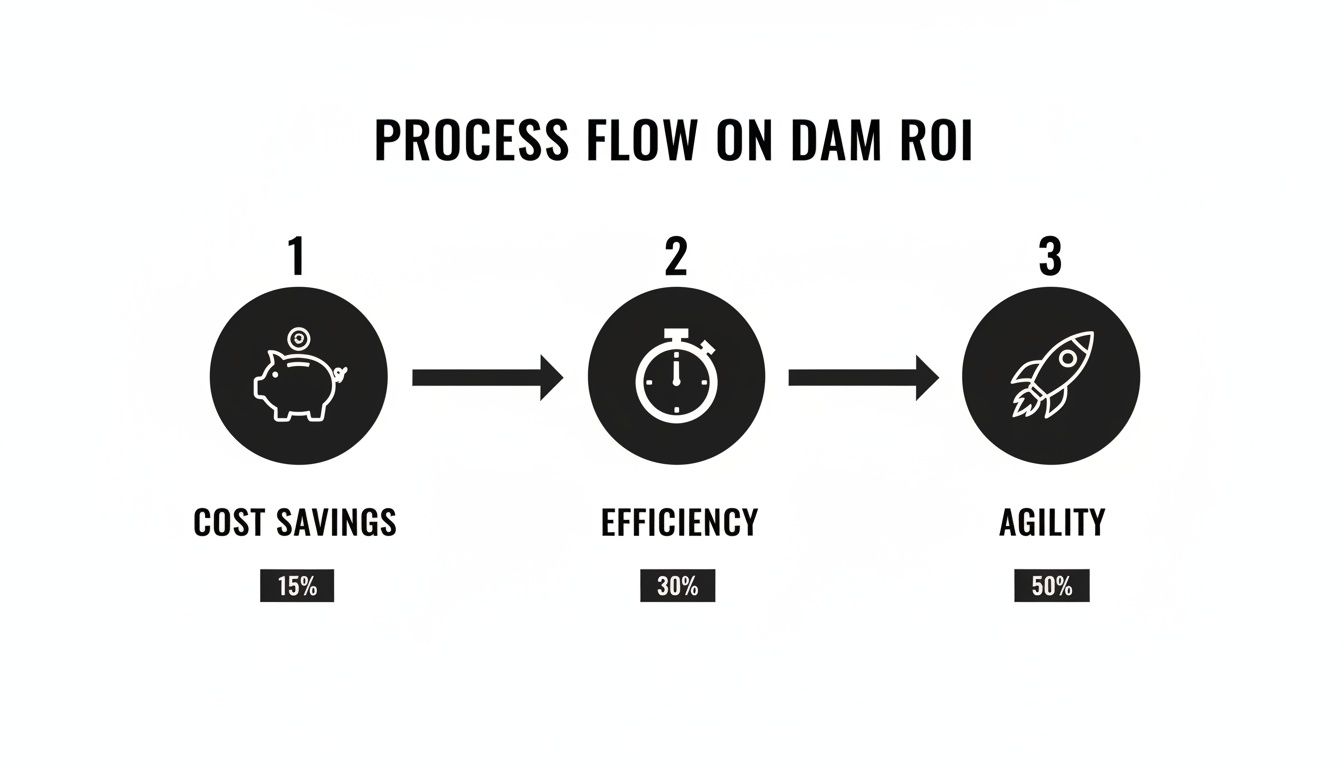
This process illustrates how a well-executed implementation translates directly into tangible business outcomes, with increased agility often representing the most significant long-term strategic advantage.
Training must be tailored to specific user roles. A graphic designer's interaction with the system differs significantly from that of a salesperson who needs to quickly find and download a presentation. By clearly articulating the value proposition for each user group ("what's in it for me") and providing practical, hands-on guidance, organisations can ensure the platform is not merely implemented, but fully embraced, thereby unlocking its true potential.
The Future of DAM: AI-Driven and Predictive
The digital asset management landscape is undergoing rapid transformation, with Artificial Intelligence as the primary catalyst. The DAM of the future will not be a passive digital library but an intelligent, proactive content engine that informs strategic decision-making and drives innovation.
This is not a distant vision; it is the current reality. Forward-thinking organisations are already moving beyond basic AI features like automated tagging. They are exploring next-generation capabilities that can predict team needs and accelerate value creation, fundamentally reshaping creative and marketing workflows.
Ready to Build Your AI Project?
Let's discuss how we can help you ship your AI project in weeks instead of months.
From Reactive Storage to Proactive Intelligence
The future of digital asset management software lies in its ability to predict, create, and adapt dynamically. This intelligence manifests in several powerful ways that directly enhance campaign performance and operational efficiency. The DAM will evolve from a content repository to a strategic advisor.
Emerging capabilities include:
- Predictive Performance Analytics: AI algorithms will analyze historical data to predict which visual assets will resonate most effectively with specific audience segments, informing creative strategy before campaign execution begins.
- Automated Content Generation: Integrated AI tools will automatically generate video highlights optimised for various social media platforms or produce on-brand copy variations for A/B testing at scale.
- Intelligent Content Curation: The system will proactively recommend relevant assets to teams based on active projects, recent search trends, or upcoming campaign briefs, eliminating the need for manual discovery.
This evolution is particularly relevant in Germany's rapidly expanding market. Large enterprises, expected to account for 67.8% of 2025 revenues, are driving much of this growth through deep integration of DAM with their ERP, CRM, and marketing automation systems. For these organisations, an intelligent DAM that elevates the entire content lifecycle is a significant competitive advantage.
The Expanding Universe of Digital Assets
Simultaneously, the definition of a "digital asset" is broadening. A future-proof DAM must be capable of managing more than standard images and videos. As businesses explore more immersive customer experiences, the platform must accommodate complex, next-generation file types.
The DAM is becoming the central repository for the building blocks of the metaverse and augmented reality. Its ability to govern these complex assets will be critical for brands looking to innovate in customer engagement and product visualisation.
Want to Accelerate Your Innovation?
Our team of experts can help you turn ideas into production-ready solutions.
This includes the management of:
- 3D Models: Essential for e-commerce product visualisation, virtual showrooms, and industrial design.
- Augmented Reality (AR) Experiences: Enabling customers to visualize products in their own environments.
- Interactive Content: Such as configurable product demonstrators or immersive training modules.
Properly managing these advanced assets requires deep, domain-specific knowledge. The criticality of this is explored further in our analysis of why RAG becomes unstable without proper domain knowledge capture. As these new formats become standard, the DAM will solidify its position as the central hub of the corporate content supply chain, empowering teams to innovate with speed and confidence.
Your Burning Questions About Enterprise DAM
When senior leaders evaluate new technology platforms, a consistent set of strategic questions arises. Here are direct answers to common inquiries about enterprise-grade digital asset management software, framed for decision-makers.
What is the fundamental difference between a DAM and cloud storage? The distinction is intelligence. Cloud storage solutions like Google Drive or Dropbox function as digital filing cabinets. They are effective for storing and sharing files but are fundamentally passive. They offer minimal control over how an asset is used or its journey through the organisational workflow.
A DAM, in contrast, is an active command centre for content. It is engineered to manage the entire asset lifecycle—from creation and review to distribution and archival. It enriches files with valuable metadata, maintains version histories, and automates the management of usage rights. It transforms a disorganized collection of files into an intelligent, searchable, and strategic corporate asset.
How Long Does This Actually Take to Implement?
For a large German enterprise, a properly phased implementation typically requires three to nine months. This timeline encompasses the full project lifecycle, including initial discovery and strategy, system configuration, content migration, integration with other enterprise systems, and comprehensive team training.
To accelerate time-to-value, a focused pilot program is a recommended approach. This allows a single department or project team to achieve an early success, generating internal momentum. This de-risks the broader, enterprise-wide rollout and ensures the solution is precisely calibrated to business needs before scaling.
A common pitfall is to view a DAM as merely another software installation. It is a new operational model. Success is less dependent on the technology itself and more on a well-executed change management program.
How Do We Get Our Teams to Actually Use It?
Driving user adoption is the single most critical factor in achieving a return on investment. Success hinges on a robust change management plan that extends far beyond initial training sessions.
Effective strategies include:
Looking for AI Expertise?
Get in touch to explore how AI can transform your business.
- Visible Executive Sponsorship: Leadership must consistently communicate that the DAM is a strategic priority, not an optional IT project.
- Role-Based Training: Generic system walkthroughs are insufficient. Training must be tailored to demonstrate how the DAM solves specific, daily challenges for different teams, from creative to sales, thereby making their roles more effective.
- Internal Champions Program: Identify influential individuals within key departments and empower them as advocates. These champions can provide peer-to-peer support and articulate the system's benefits from an end-user perspective.
By focusing on the human element of this technological shift, you ensure your new digital asset management software becomes an indispensable tool in daily operations. This is when its full potential to enhance efficiency and protect the brand is truly unlocked.
At Reruption GmbH, we act as your co-preneurs to implement AI-powered systems that drive real business outcomes. We specialise in turning complex technological possibilities into production-ready innovations. Discover how we can help you build your AI-driven future.